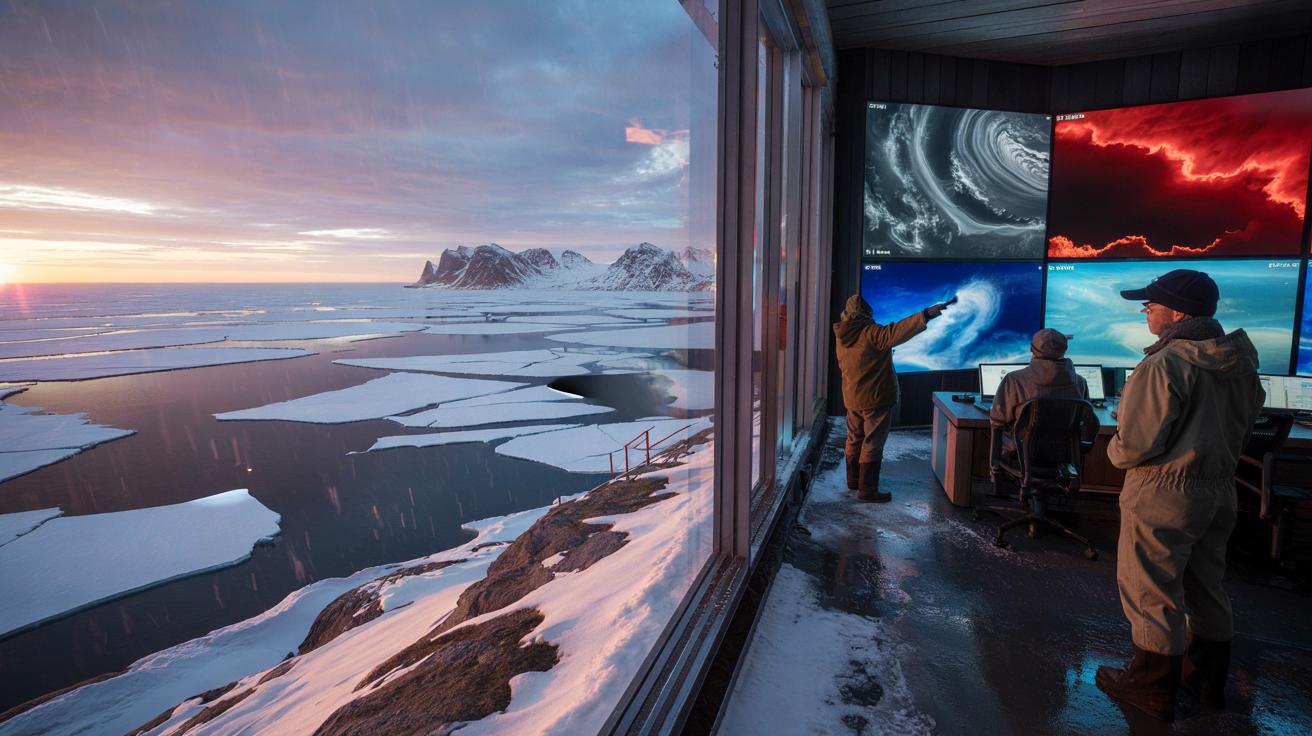
At 8:12 on a gray February morning, the Arctic looked wrong.
On the satellite feed in the corner of the forecasting room, the ice cap should have been a clean, hard white, like old porcelain. Instead, patches of ghostly blue bled through — open water where there should be winter silence.
A young forecaster in Tromsø zoomed in, rubbed his eyes, then checked the date twice. Someone muttered that the map looked like late April. The room fell quiet in that particular way scientists go quiet when their models and their gut start to argue.
Out the window, snow drifted lazily past the glass. On the screen, the Arctic was refusing to play by the rules.
Something has slipped out of the script.
Early February and an Arctic that behaves like April
For decades, early February was the Arctic’s deep-freeze moment.
Sea ice nearing its maximum, polar air locked in place, brutal cold sealed over the top of the planet like a lid. This year, that lid looks cracked.
Meteorologists tracking the high north say surface air temperatures have spiked up to 10–15°C above the seasonal norm in some zones. That’s not a glitch, that’s a pattern. The ice edge has retreated northward, and warm pulses of Atlantic and Pacific air are rushing into places that, until recently, behaved like a cold, stubborn fortress.
The word they keep repeating is unsettling: **“uncharted.”**
A few days ago, a team at the European Centre for Medium-Range Weather Forecasts watched an atmospheric river — a long plume of moist, warmer air — curl right into the central Arctic Ocean.
Those rivers used to be mostly a mid-latitude story; now they’re barging into the polar night, raining on snow that’s meant to stay frozen solid.
In Svalbard, a mining town that sits at the edge of the polar desert, February used to mean squeaky snow under boots and diesel engines that never really shut off. This year, residents reported slushy streets, freezing rain, and roofs groaning under heavy, wet snowpack. Ski trips were canceled not for blizzards, but for avalanche risk on melting layers.
The calendar still says winter. The ground feels more like a seasonal mash‑up.
➡️ No vinegar and no baking soda: pour half a glass of this and the drain practically cleans itself
➡️ Neither swimming nor Pilates: the best activity for people with knee pain
➡️ This haircut works well for women over 50 who want movement at the ends
For meteorologists, this isn’t just weird weather. It’s physics, calling in its debt.
Warmer oceans release more heat into the air. Thinner, younger ice allows that heat to escape faster. Darker open water absorbs sunlight that old, thick ice used to reflect back into space.
That feedback loop means the Arctic is heating up roughly four times faster than the global average, a process researchers call Arctic amplification. When that much extra energy enters the system, the jet stream — that high‑altitude river of wind that steers storms — starts to wobble and buckle. Those bends can lock in place, sending freakishly warm air north, and sometimes brutal cold south.
The end result reaches far beyond the polar circle. The Arctic is no longer just a remote victim; it’s becoming a restless driver of the weather we live in.
Reading the new Arctic signals like a weather manual
Behind each alarming graphic, there’s a fairly simple move meteorologists are learning to repeat: watch the baselines, not the headlines.
The single freak warm day is less worrying than the slow, steady shift of what “normal” looks like.
Teams are tracking three signals with near-obsessive focus. First, sea-ice extent — not just how big the ice cap is in early February, but how thick and how old that ice remains. Second, surface temperature anomalies, those maps splashed in red and blue that show where the air has drifted off course from historical averages. Third, circulation patterns in the high atmosphere, where subtle twists can spell a wild month for cities thousands of kilometers away.
That quiet recalibration of “normal” is the step that changes everything.
The average person doesn’t spend their day poring over Arctic ice charts, and that’s fair.
Most of us feel these shifts in smaller, stranger ways: rain on what used to be a solid snow day, a week of freak warmth in midwinter, thunderstorms firing over frozen ground.
Meteorologists now link some of those experiences to specific Arctic patterns. When sea ice in the Barents and Kara Seas stays low, Europe sees a higher risk of stuck weather — stalled storms, lingering high-pressure domes, drawn-out cold snaps or long, gray, mild spells. When the Bering Sea runs unusually warm and ice‑free, North America can see a disrupted jet stream that whipsaws between polar blasts and shirtsleeve weather.
We’ve all been there, that moment when you stare at your winter coat and your phone app and wonder which one has lost its mind.
From a forecasting desk, this Arctic shift feels like learning a familiar language that suddenly picked up new grammar.
Old rules of thumb — “by February, the ice will…” or “this pattern means three more weeks of cold” — now break more often than they hold.
Some researchers argue that a weaker temperature contrast between the poles and the tropics is slowing elements of the jet stream, making it wavier and more prone to parking over the same region. Others push back, warning that the data is messy and the climate system loves to surprise. Both camps agree on at least one plain-truth sentence: the Arctic is warming fast, and that warmth is not staying politely put.
*The uncharted part is not just how warm it gets, but how the atmosphere rearranges itself around that warmth.*
Living with an Arctic that refuses to sit still
For people far from any iceberg, the question becomes brutally practical: how do you live with a capricious Arctic?
Meteorologists quietly suggest a small but powerful habit — not climate guilt, not doom‑scrolling, just upgrading how we read the forecast.
Instead of glancing only at today’s icon, they advise tracking patterns over a week or two. Notice when your local forecast starts using language like “record mild for the season” or “unusual rain-snow mix” in midwinter. Pay attention when those phrases repeat, year after year. That’s where the Arctic is whispering into your daily life.
No one needs to be a scientist to sense that winter is losing its script. You just need to listen a little differently.
There’s a quiet fatigue that creeps in when every year seems to break a record.
People tune out, scroll past, or joke that “seasons are canceled now.” Meteorologists feel that too; many will tell you they never signed up to be messengers of bad news.
They warn against two common traps. One is shrugging off every weird winter as “just weather,” a random blip with no story behind it. The other is assuming every warm day is the end of the world by Thursday. Both reactions miss the slow, structural shift underway. Let’s be honest: nobody really changes their life every single time a scary chart goes viral.
What they hope for instead is a steadier awareness — the kind you build the way you learn a neighborhood by walking it, day after day.
“From a forecasting perspective, early February used to be the safest part of the calendar,” says one senior polar meteorologist. “Now, every year, we’re rewriting the margins of what’s possible. The Arctic used to be our anchor. It’s starting to feel like a wild card.”
- Watch the Arctic headlines, not just your local forecast
- Link weird winter days to larger patterns instead of treating them as isolated flukes
- Stay curious about sea-ice records and polar temperature spikes — they’re not abstract
- Avoid all-or-nothing thinking: neither denial nor constant catastrophe mode helps
- Use these signals as prompts for small, concrete actions where you live
A polar story that doesn’t stay in the polar circle
The phrase “uncharted Arctic” can sound like something out of a science documentary — distant, sterile, happening on another planet made of white silence.
Yet the reality in early February 2026 is closer to a neighborhood story than a nature special. The air that slips over a patch of open Arctic water may end up steering the storm that floods your basement, or the dry high-pressure dome that leaves your fields thirsty.
Meteorologists are, by training, cautious with big words. When they start talking about boundaries being crossed, it’s because their spreadsheets and their instincts are finally saying the same thing. The top of the world is moving into regimes our past data can’t fully describe. That doesn’t mean everything is chaos from now on; it means the old comfort of “we’ve seen this before” doesn’t always apply.
How you respond — with denial, with quiet adjustment, with creative stubbornness — is the part of the story no model can predict yet. The Arctic is changing the rules of the game. What each of us does with that knowledge is still unwritten.
| Key point | Detail | Value for the reader |
|---|---|---|
| Early February signals are off the charts | Arctic air up to 10–15°C warmer than normal and reduced sea ice extent | Helps explain why winter feels unpredictable and sometimes out of season |
| Arctic warmth reshapes weather far away | Wavier jet stream, stalled patterns, and increased risk of extremes in mid‑latitudes | Connects polar changes to flooding, heat, or cold spells where you live |
| Small habits can track a big shift | Watching recurring “record mild” or strange winter events over years | Gives a grounded way to notice climate change beyond headlines |
FAQ:
- Question 1What do meteorologists mean when they say the Arctic is “uncharted” right now?
- Question 2Is one warm February in the Arctic enough to prove climate change?
- Question 3How does a warmer Arctic affect winter storms where I live?
- Question 4Could the Arctic still have very cold spells even as it warms overall?
- Question 5What can an ordinary person realistically do with this information?