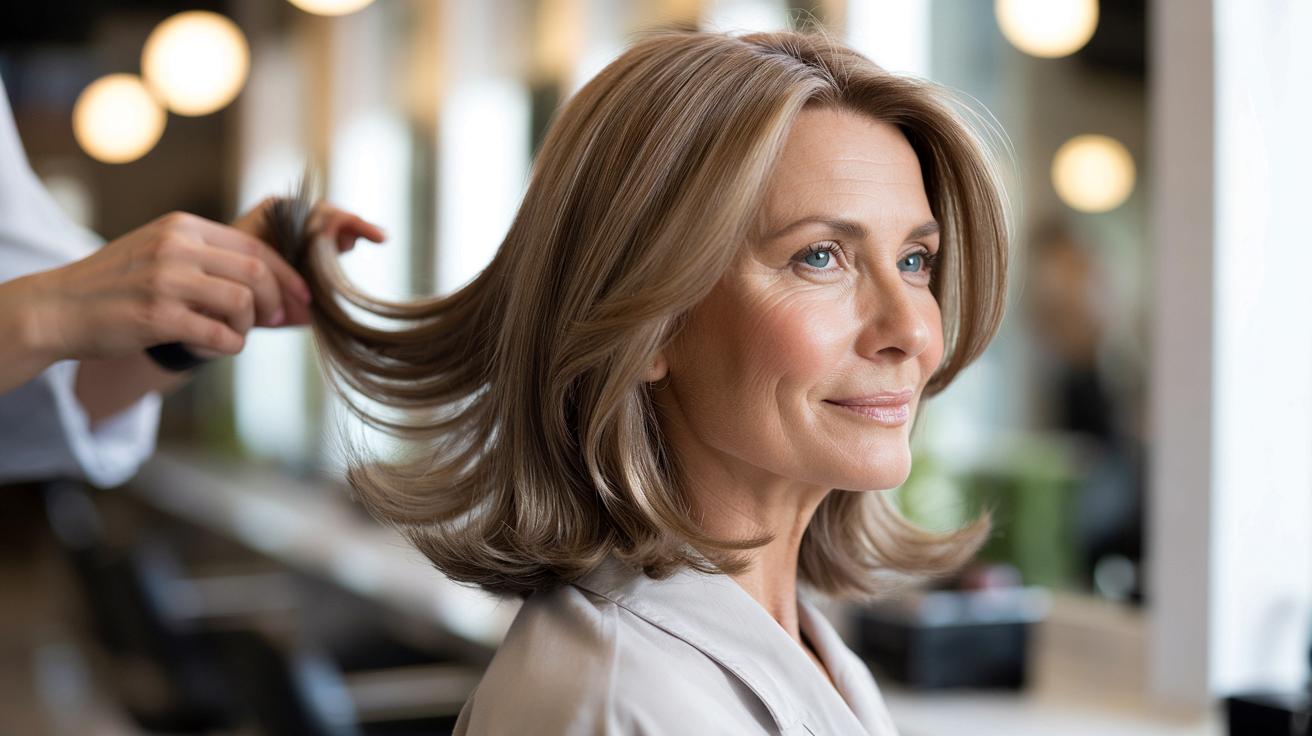
The stylist had barely fastened the cape around her neck when Claire, 56, blurted it out: “I just don’t want my hair to look tired anymore.”
The mirror showed a familiar picture – shoulder-length hair hanging straight down, ends heavy, the kind of cut that looks fine from afar but flat in real life.
The stylist didn’t reach for the scissors right away.
She lifted the bottom sections, shook them gently and said, almost like a verdict: “All the life is missing at the ends. We’re going to give them movement.”
Twenty-five minutes later, Claire was turning her head left and right, watching the tips of her hair dance over her collarbones. She looked like herself, just lighter, sharper, more awake.
She hadn’t lost length. She’d gained air.
There is one particular cut that does exactly that for women over 50.
The invisible problem: when “good” hair starts to feel heavy
You don’t wake up one day with “old” hair.
It’s more subtle than that. Your cut that used to work suddenly feels too compact, the ends start sticking together, and photos reveal a block of hair that doesn’t move when you smile.
From 50 onwards, texture quietly changes.
Strands get a little drier, a little thinner, and the once-easy blow-dry needs more time.
What looked glossy at 35 can read as rigid at 55, especially when the ends are blunt and all the weight sits on the bottom line.
That’s when many women think they need to go short.
They usually don’t. They need movement at the ends.
Take Elena, 52, a marketing director who swore she was “not a short-hair person.”
Her routine: a straight, below-shoulder cut she trimmed “once or twice a year” at the cheap salon next to the supermarket. It felt efficient, safe, low fuss.
One day, her daughter filmed her blowing out birthday candles.
Elena watched the video and realized her hair stayed frozen around her face while she leaned forward. “I looked like my hair was painted on,” she said. “I didn’t feel that way inside at all.”
She booked an appointment at a recommended salon.
The stylist suggested a medium-length cut with soft, internal layers and lightly textured ends.
Same length, new energy. On camera, the difference was huge: the tips flipped, curved, grazed her jaw when she laughed. Someone in the office asked if she’d changed her skincare.
It was just the haircut.
➡️ Neither swimming nor Pilates: the best activity for people with knee pain
➡️ No vinegar and no baking soda: pour half a glass of this and the drain practically cleans itself
➡️ Meteorologists warn early February signals suggest the Arctic is entering uncharted territory
The logic is simple.
When all the weight gathers at the bottom, hair behaves like a curtain. Straight, static, a single line. As density shifts with age, this block of weight can drag facial features down visually.
A cut that introduces light movement at the ends breaks that line.
Soft layers placed mostly through the lower third of the hair, with gentle tapering at the tips, allow strands to separate slightly, catch the light, lift off the shoulders. The eye suddenly sees angles again: cheekbones, jawline, neck.
This is why the right “movement” cut looks rejuvenating without being obviously anti-aging.
It doesn’t shout. It just restores harmony between your face and your hair.
*The goal isn’t to look younger, it’s to look more like how you still feel inside.*
The cut that changes everything: soft, moving ends on a mid-length base
The version that works for most women over 50 sits somewhere between the collarbones and the top of the shoulders.
Think a modern lob or a “soft mid-length” cut with discreet layers and airy, textured ends.
The base stays fairly clean so you keep that polished outline.
Then the magic happens in the bottom 5–7 centimeters: the stylist removes excess bulk, slices tiny channels through thick areas, and slightly softens the perimeter. The line is still there, just not brutally straight.
This creates movement you can actually see when you walk.
Ends swing, flip, curve under or out with the slightest styling.
Your hair still feels like “long hair” emotionally, yet it doesn’t drag your features down.
The biggest trap is asking vaguely for “layers” or “something fresh.”
That’s how women walk out with choppy, over-layered hair they’ll spend months growing out. The secret here is restraint. You want light shaping through the lower section, not 90s-style steps.
A good way to brief your stylist: bring a photo where the ends look alive, not exploded.
Point specifically to the last few centimeters and say, “I want movement here, but I don’t want to lose thickness up top.”
Let’s be honest: nobody really does a full round-brush blowout every single day.
This cut should work with quick habits – a rough dry, a few passes of a large curling iron on the bottom only, or just scrunching a bit of styling cream into the tips.
If the cut is right, the hair almost styles itself as it dries.
“After 50, I cut less from the length and more from the weight,” says Paris-based hairstylist Anaïs Morel, who works mainly with clients between 45 and 70. “The trick is to carve air into the ends without taking away the feeling of fullness. Women want to see their hair move when they turn their head, not see the floor covered in it during the cut.”
- Ask for a mid-length base
Between collarbone and shoulders, not shorter, not mid-back. This gives enough length for movement while staying light. - Focus layers on the bottom third
You want internal layers that start low, so the crown doesn’t go flat but the volume stays natural, especially around the jaw. - Insist on soft, textured ends
Not shredded, not feathery. Just gently tapered tips that separate slightly and move as you walk or talk.
Living with the cut: small rituals, big difference
What surprises most women is how low-pressure this haircut feels day to day.
Because the movement sits mainly at the ends, you don’t have to chase volume at the roots with five products and a prayer.
A simple routine is often enough.
Towel-dry, add a light styling cream or volumizing spray to the mid-lengths, then dry the hair with your head slightly tilted, guiding the ends with your fingers. A large round brush is nice, not mandatory.
On dry hair, a few twists with a wide-barrel iron only on the bottom sections mimic that salon bounce in under five minutes.
The cut does the rest.
There is one thing that kills movement: letting the shape grow out for a full year “because it’s easier.”
When the ends get heavy again, the air disappears, and the whole point of the cut vanishes. The line thickens, the tips clump, and you’re back to that solid block.
Most stylists suggest a light refresh every 8 to 12 weeks.
Not a big transformation, just a weight check: remove a bit of bulk at the ends, re-polish the perimeter, revive the texture. If you color your hair, syncing the cut with touch-ups keeps everything looking intentional, not accidental.
If you’re reading this thinking, “I’ve already had my hair ruined by layers,” that fear is valid.
The difference now is precision: this is about millimeters, not centimeters. The right stylist measures the snips in their head before the scissors even open.
Around this age, hair choices are never just “beauty decisions.”
They’re a quiet negotiation with how you see yourself, how others see you, and who you feel you’re allowed to be. The haircut with movement at the ends lands right in that sweet spot: flattering, current, but not screaming for attention.
Some women tell their stylist, “I want people to say I look rested, not ask if I had ‘work’ done.”
This is exactly that kind of change.
You keep your length, your habits, your identity.
You trade only one thing: that heavy, tired line at the bottom for small, deliberate swishes of hair that follow your face when you speak.
The mirror doesn’t lie, but it can be kinder when your hair moves the way you do.
| Key point | Detail | Value for the reader |
|---|---|---|
| Mid-length base | Cut between collarbone and shoulders to balance lightness and presence | Retains the feel of long hair while visually lifting the face |
| Movement focused on the ends | Soft internal layers and lightly textured tips in the bottom third | Creates visible swing and softness without sacrificing thickness |
| Regular, light maintenance | Trim and re-texture every 8–12 weeks, minimal daily styling | Hair keeps its shape and bounce with a realistic routine |
FAQ:
- Question 1Will this kind of cut make my hair look thinner?
- Answer 1
- No, if it’s done well. The density is preserved near the roots and mid-lengths, while only excess weight is removed from the ends, which usually makes hair look fuller and more dynamic overall.
- Question 2Does it work on naturally curly or wavy hair?
- Answer 2
- Yes, and it can be stunning. The key is cutting curl by curl or on dry hair, so the movement at the ends enhances your natural pattern instead of breaking it up awkwardly.
- Question 3What if I have very fine hair?
- Answer 3
- Your stylist will go lighter on the internal layers and focus mostly on a gentle tapering of the tips. The goal is subtle separation, not dramatic de-bulking.
- Question 4How do I describe this haircut to my stylist?
- Answer 4
- Ask for a collarbone-to-shoulder length cut with a clean outline, soft internal layers mainly in the bottom third, and lightly textured ends for movement, then show 2–3 reference photos.
- Question 5Can I grow my hair longer again later?
- Answer 5
- Absolutely. This technique doesn’t prevent growth; it just refines the shape as it grows, so your hair will actually look better during the growing-out phase.