The physio room is quiet except for the soft squeak of sneakers on vinyl. A woman in her fifties, leggings rolled above swollen knees, looks at the row of treadmills with a mix of envy and fear. Her doctor told her to “stay active” but didn’t say how, and every time she tries to jog, her joints protest for three days. Swimming bores her. Pilates feels like a foreign language. So she sits, pretending to check her phone, hoping someone will just tell her what to do.
Across the room, a small group moves in slow, controlled steps. No jumping. No twisting. Just a strange sort of focused walking.
The physio calls it the secret weapon for bad knees.
The unexpected activity that quietly saves bad knees
The activity that keeps coming up in ortho clinics and sports rehab centers isn’t glamorous. No trendy gear. No flashy hashtags. Yet it keeps reappearing in research papers and doctor’s recommendations for people who say, “My knees can’t take much anymore.”
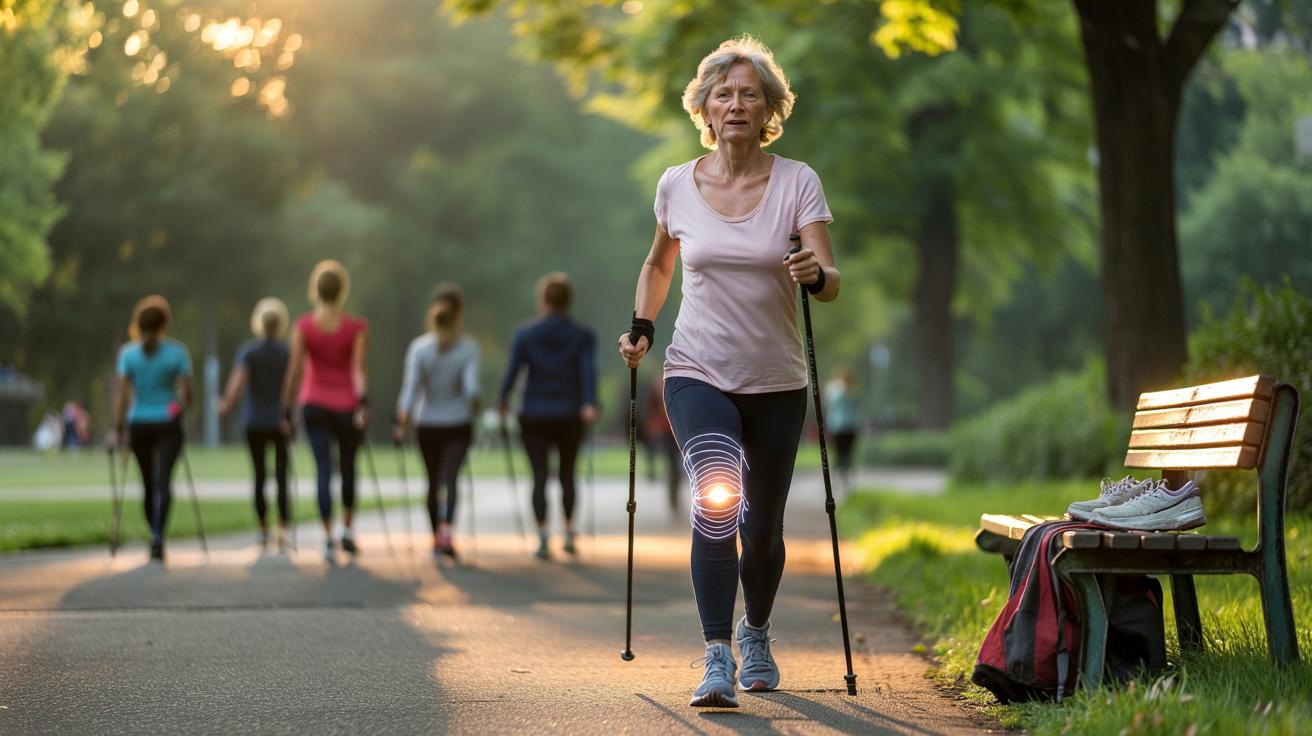
It’s called Nordic walking: walking with specially designed poles, using both arms and legs in a coordinated way.
From the outside, it looks a bit like skiing without the snow. From the inside, it feels like finally having a body that moves as one piece instead of joints fighting each other.
A French rheumatologist I spoke with described the same scene week after week. People with knee osteoarthritis entering her office convinced that their only options were painkillers, pool sessions, or giving up. She started sending them to a local Nordic walking group as a sort of experiment.
Three months later, they came back with the same sentence on their lips: “I thought my knees were done. They’re not.”
One woman in her early sixties, who used to dread climbing stairs, told me she’d gone from 800 to 6,000 steps a day without extra pain. Just by swapping aimless walking for structured walking with poles, two sessions a week. Her knees weren’t healed. Her life just hurt less.
The logic is surprisingly simple. Nordic walking spreads the workload across the whole body instead of dumping it on the knees. The poles act like a second pair of legs, offloading some of the pressure on the joints, especially on slopes or longer distances.
➡️ No vinegar and no baking soda: pour half a glass of this and the drain practically cleans itself
➡️ This haircut works well for women over 50 who want movement at the ends
➡️ Meteorologists warn early February signals suggest the Arctic is entering uncharted territory
At the same time, using the arms keeps your upper body engaged, which boosts calorie burn and cardiovascular work without needing to walk faster. You get a workout that feels moderate, yet your heart rate says otherwise.
For knees that complain at every impact, that redistribution is gold. Less brutal load, more muscle support, more stability around a joint that’s often afraid of missteps.
How to start Nordic walking when your knees are already grumpy
The first thing is not the poles. It’s the pace. If your knees already hurt, your goal is “easy but precise”, not “sporty and heroic”.
Begin on flat, forgiving ground: park paths, compact earth, or a track. Ten to fifteen minutes the first time, at a pace where you can still talk. Then add five minutes every few outings if your knees tolerate it.
Only then do the poles become your best allies. Adjust them so your elbows form roughly a right angle when you hold the grips. Let the tips touch the ground slightly behind your feet, not in front. The idea is to push, not to stab.
Most beginners make the same two mistakes: gripping the poles like they’re hanging off a cliff, and walking with stiff, robotic steps. Both fatigue the shoulders and do nothing for the knees.
Think of the poles as a discreet assistance, not crutches. Your hands open slightly when the arm swings back, then close again when it comes forward. The movement stays fluid, like a casual walk where your arms just have… more purpose.
And if the first outing feels awkward, that’s normal. We’ve all been there, that moment when you feel like the weirdest person in the park. Give yourself three sessions before judging.
“People think Nordic walking is ‘too easy’ until they do it properly,” says sports physician Dr. Léa Martin. “Then they realise they’re breathing harder, sweating more, and their knees complain less. For someone with chronic knee pain, that combination is rare and precious.”
- Use forgiving terrain first
Flat park paths, forest tracks, or riverbanks are your training ground before you tackle hills. - Pick the right pole length
Adjust so your forearms are roughly parallel to the ground when holding the grips upright. - Focus on the natural arm–leg rhythm
Right arm goes with left leg, left arm with right leg, just like regular walking. - Start with short sessions
Two 15–20 minute outings a week can already ease stiffness without overwhelming your joints. - Listen to “good fatigue” vs. sharp pain
Mild muscle soreness around the thighs or glutes is normal; stabbing pain inside the knee is a stop signal.
When walking with poles becomes more than “just walking”
Something strange happens after a few weeks of Nordic walking. People stop talking only about their knees. They start mentioning better sleep, lighter mood, a sense of “getting their body back”.
This isn’t magic. It’s the ripple effect of finally having an activity that feels sustainable. You’re outdoors, moving rhythmically, not dreading every step. You start planning walks instead of planning around pain.
*And that tiny shift from fear to anticipation changes more than any prescription on paper.*
| Key point | Detail | Value for the reader |
|---|---|---|
| Offloading knee joints | Poles redistribute weight across arms, core, and legs | Less pressure on painful knees while staying active |
| Building protective muscles | Strengthens thighs, hips, and glutes in a low-impact way | Better joint stability and fewer “bad step” episodes |
| Sustainable routine | Accessible outdoors, adaptable duration, social if done in groups | Higher chance of sticking with movement over the long term |
FAQ:
- Question 1Does Nordic walking really hurt less than regular walking for bad knees?
- Question 2Do I need special poles, or can I use trekking poles I already have?
- Question 3How often should I practice if my knees are sensitive?
- Question 4Is Nordic walking useful if I’m already doing swimming or Pilates?
- Question 5What if I’m overweight and afraid my knees won’t handle any extra activity?